

AB 2159-Compliant Electronic Voting
California now allows electronic voting for HOA elections. Run secure elections with anonymous ballots, complete audit trails, and homeowner trust.
Attend from anywhere
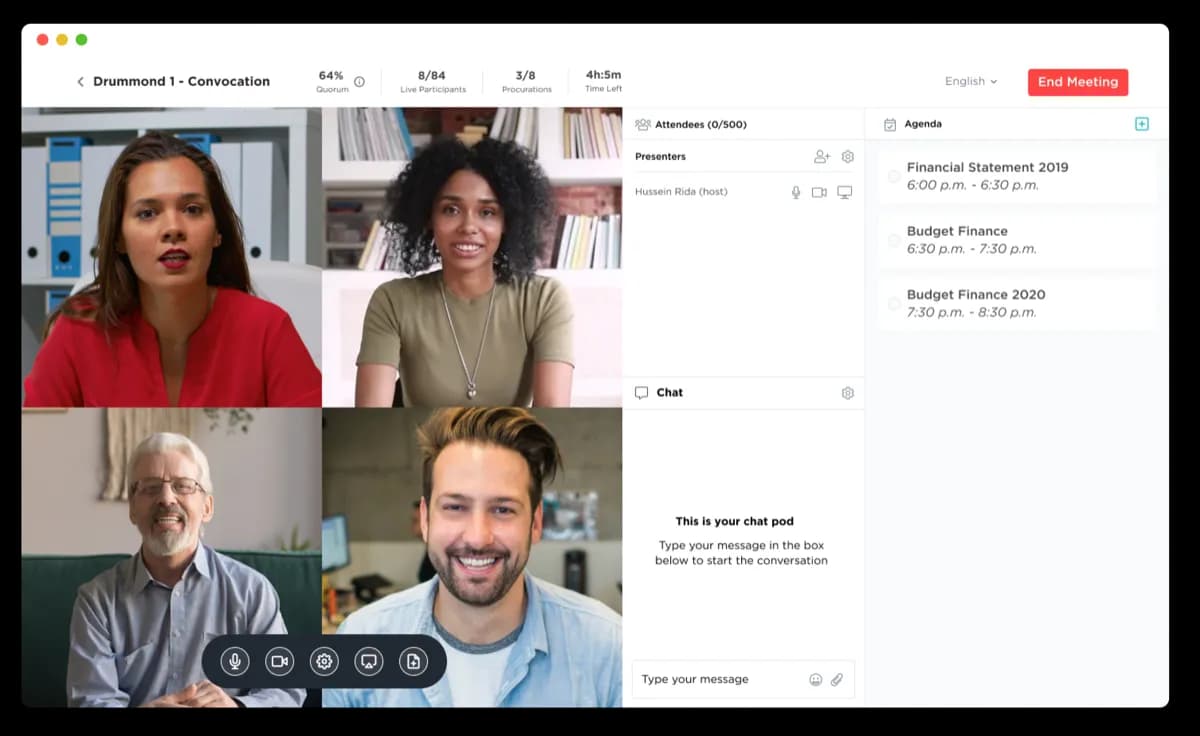
Non-attendance due to constraints is a thing of the past. Your homeowners deserve a secure portal to attend and participate in meetings from anywhere giving everyone complete peace of mind.

Live Quorum
Propty calculates quorum in real-time so you know whether your meeting is valid to proceed right from the start.

Secure Online Voting
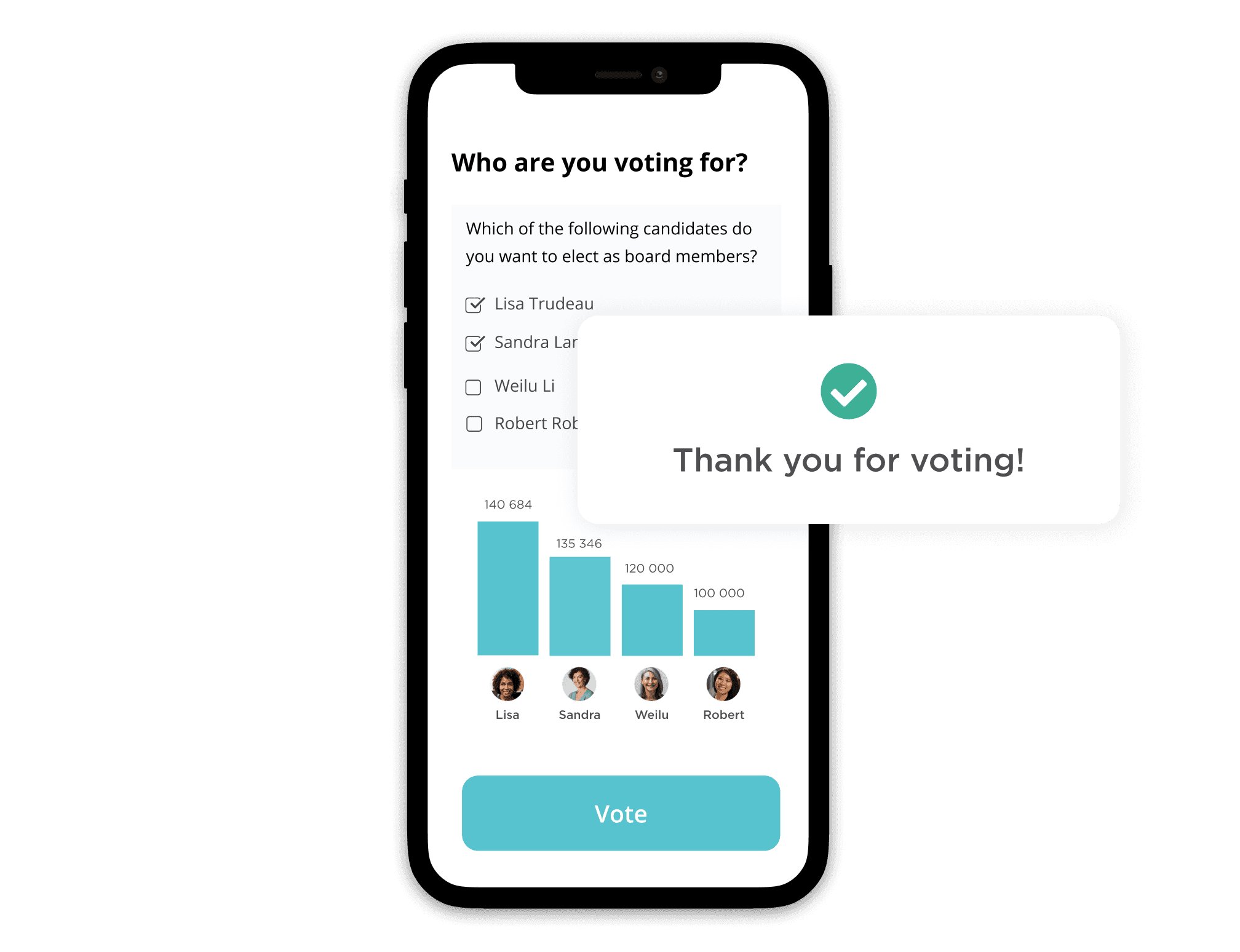
Hold anonymous and secure elections with a few clicks. Whether it's a board election or budget approval, watch the results in real-time with complete audit trails.
Simplify proxies
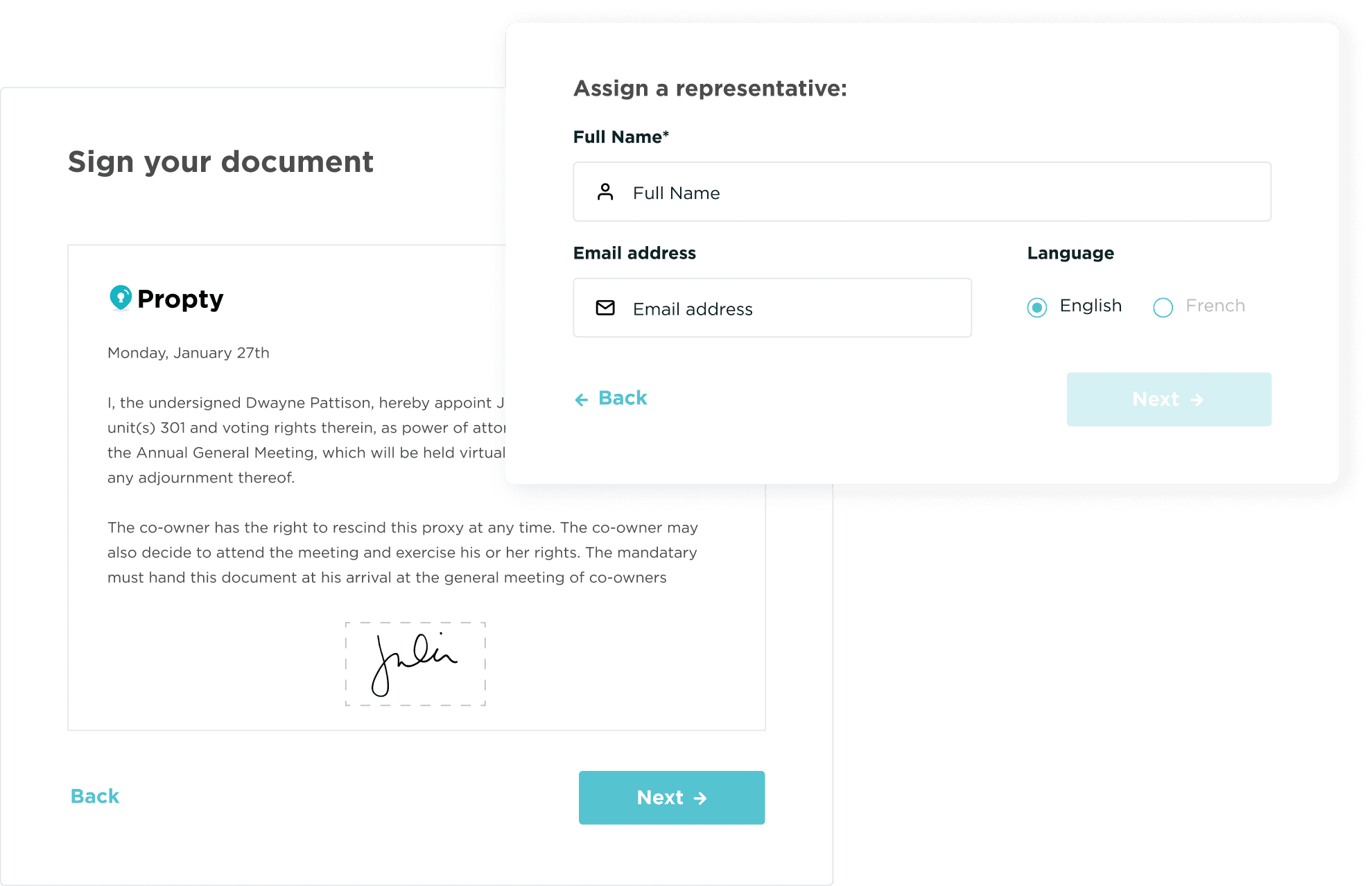
Still can't attend the annual meeting? Assign a representative and sign the proxy form digitally, saving you hours of emails and filling forms manually.
Built for California HOAs

AB 2159 Compliant
Meets all California requirements for electronic voting in HOA elections—anonymous ballots, secure authentication, and complete audit trails.
Inspector of Elections Support
Workflow designed to support Inspector of Elections duties with proper ballot handling and verification procedures.
Ballot Secrecy
Anonymous voting ensures ballot secrecy while maintaining complete audit trails for verification if disputes arise.
eSignature
By authorizing and authenticating the signature, you can rest assured that the right person submitted the information.
Recording
Record the entire meeting, including the video conference, the chat, and all the important statistics in case a meeting review is needed.
Participants Activity
Know whether each participant has voted and the total participation duration or even the time they joined and left the meeting.
Data import
We make it super easy for you to import your participants via Excel regardless of the property management application you're using.
Real-time Statistics
Access important insights like meeting's quorum, participation ratio, and a number of proxies, and best of all, it's in real-time.
Complete Audit Trail
Generate a detailed report including meeting minutes, stats, election results and all participant's activities—documentation that protects your board.
Running a Davis-Stirling-compliant annual meeting, step by step
Civil Code §§5100–5145 sets out the procedure for every California HOA election held at an annual meeting — and the procedure is unforgiving. Start at least 90 days out: confirm your written election rules comply with the AB 1170 2026 content updates and have been adopted with the §5105(c) 28-day member-notice procedure. Sixty to forty-five days out: appoint the Inspector of Elections under §5110, confirming the Inspector is not a director, not a candidate, and not a relative of either. Forty days out: distribute the §5115(a) pre-ballot notice opening nominations. Thirty days out: build the candidate list with equal-access campaign rules under §5105(a)(7), then mail double-envelope ballots — outer envelope signed and identifying the unit, inner envelope anonymous. Election day: the Inspector verifies outer-envelope signatures against the membership list, separates outer from inner, opens inner envelopes, and tabulates. Within 15 days after: announce results to the membership and record them in the next board meeting's minutes (§5120(c)). Then retain ballots, voter list, candidate list, and Inspector records for one year (§5125). Skipping or compressing any step exposes the election to a §5145 challenge. Propty's annual meeting workflow tracks each deadline against the published meeting date and prompts the next action — eliminating the most common procedural failure mode: a board that knew the deadlines existed but missed them anyway.
Inspector of Elections: who can serve, who can't
About a third of California HOA election challenges turn on Inspector eligibility — usually because the Inspector turned out to be related to a candidate. Under §5110(b), the Inspector cannot be a current board member, cannot be a candidate, and cannot be a spouse, parent, child, sibling, or in-law of either. They also cannot have an undisclosed material relationship with the association or a candidate. 'Undisclosed' is the operative word: if the Inspector is the brother-in-law of a candidate and everyone knows it and no one objects, the relationship may still expose the election to challenge later. Volunteer Inspectors — non-board members of the community who meet the eligibility rules — are free and adequate for an uncontested annual election in a small association. Professional Inspectors (typically third-party election services or unrelated property-management-firm staffers) typically cost $400–$1,500 per election and are recommended for recall elections, assessment votes above the §5605 cap, contested director races, and any community with a history of disputed elections. Propty's Inspector workflow surfaces the §5110(b) eligibility checklist on appointment and prompts confirmation that none of the disqualifying relationships apply.
Electronic voting under AB 2159: what changed
AB 2159, phasing in through 2025 and 2026, expanded the conditions under which California HOAs may conduct director elections electronically. Before AB 2159, secret-ballot elections were essentially paper-only outside narrow exceptions. The new framework permits opt-in electronic voting provided four conditions are met. First, the association's written election rules must explicitly authorize electronic voting and describe the platform and procedure — adopted with the §5105(c) 28-day notice. Second, every member must be able to opt out and receive a paper ballot; members who do not affirmatively opt in must be sent paper. Third, the voting platform must authenticate the voter, preserve ballot secrecy (the vendor cannot link a vote to a voter), maintain an audit trail, and — critically — prevent anyone from seeing running vote tallies during the voting period. Fourth, voters must receive confirmation that their ballot was received and counted. The single most common reason e-voting elections are voided is that the platform displayed live vote counts during voting; this breaks ballot secrecy because it allows candidates to adjust campaign tactics mid-election. Propty's electronic voting is designed against this list: authentication, ballot secrecy with no vendor-side link, audit trail, no live tallies, and per-ballot receipt confirmation. The Inspector workflow tabulates electronic ballots and paper ballots in a single interface for hybrid elections.
Hybrid, in-person, or online: which annual meeting format to fit
Three meeting formats are legal under Davis-Stirling, and the right choice depends on your community size and member tech-readiness. Fully in-person meetings still work for small communities (under ~30 units) where most members live on site and gather in a shared space — quorum is easy to reach in person, and ballots can be collected at the meeting. Fully online meetings — the format that emerged during the pandemic and remains permitted — work for geographically dispersed associations and for members who travel; AB 2159 e-voting plus a video-conferencing meeting platform is fully Davis-Stirling compliant if the platform requirements are met. Hybrid meetings — some members in person, some online, ballots from both streams tabulated by the Inspector — are the most common 2026 format and the most flexible for boards whose membership mixes year-round residents and seasonal owners. Whichever format you choose, the §§5100–5145 procedural rules (secret ballot, Inspector eligibility, 30-day mailing, 15-day result announcement) apply identically. Propty supports all three: hybrid meetings are the default workflow because they accommodate the widest mix of member preferences without forcing the board to pick a format that excludes part of the community.
Frequently Asked Questions

Ready to run compliant elections?
Schedule a call with our team and see how Propty can help your California HOA.